
 Italiano
 English
 සිංහල
 தமிழ்
 Deutsch
 Español
 Français
 Nederlands
 Polski
 Português
 Türkçe
 Русский
 العربية
 فارسی
 हिन्दी
 简体中文
 日本語
 한국어

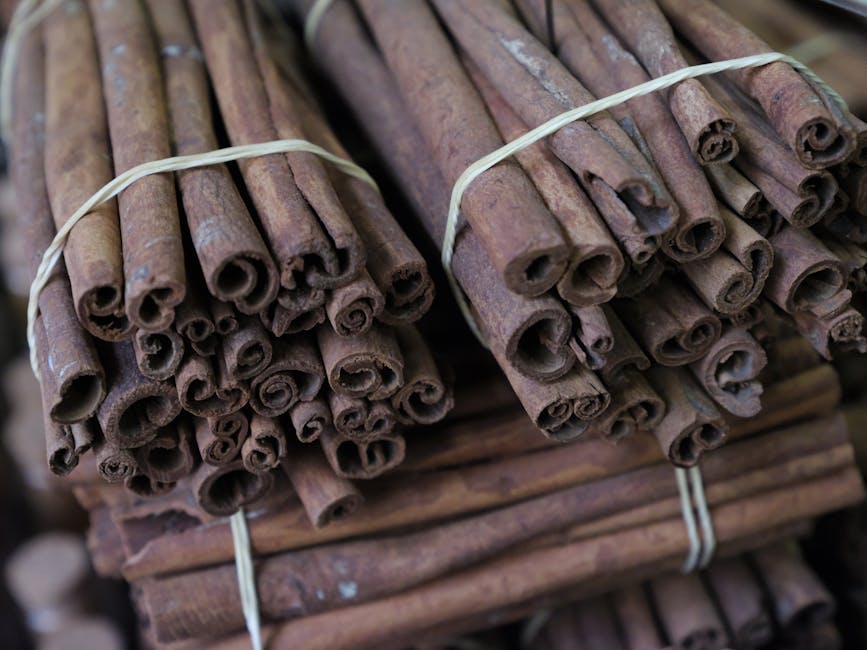
Most cinnamon sold in global bulk markets is not cinnamon. It is cassia, a related but botanically distinct spice that carries significantly higher levels of coumarin, a naturally occurring compound subject to strict regulatory limits in the EU and increasingly scrutinized in the US and UK. For buyers sourcing cinnamon at volume, the distinction is not just a matter of flavor profile. It is a compliance question.
This guide explains the botanical difference, the regulatory framework, how Ceylon cinnamon grades work, what HS codes apply, and how to verify the origin of what you are buying.
The Botanical Difference
True cinnamon, Cinnamomum verum (also written C. zeylanicum), originates in Sri Lanka. It is the inner bark of a specific laurel-family tree, harvested by hand in strips and rolled into multi-layer quills by skilled artisans. The resulting quill is soft, tan-colored, and formed of many thin layers.
Cassia refers to a group of related species: most commonly C. cassia (Chinese cassia), C. aromaticum, and C. loureiroi (Vietnamese/Saigon cinnamon; see our Saigon vs Ceylon cinnamon comparison). Cassia quills are single-layer, hard, and dark reddish-brown. Cassia represents approximately 90% of global cinnamon trade by volume and is the variety sold in most supermarkets in North America, Germany, and the Middle East.
The flavor difference is real: Ceylon cinnamon is lighter, more floral, and complex. Cassia is stronger, spicier, and more one-dimensional. For food manufacturers using cinnamon as a flavor component in high volumes, baked goods, breakfast cereals, confectionery, beverages, the regulatory implications of cassia matter more than the flavor difference.
Why Coumarin Is a Regulatory Issue
Coumarin is a naturally occurring chemical compound present in the bark of cassia species, typically at concentrations of roughly 0.1% to 4% by dry weight (highest in Saigon cinnamon). At high doses, coumarin is hepatotoxic (liver-damaging) in susceptible individuals. The European Food Safety Authority (EFSA) established a Tolerable Daily Intake (TDI) of 0.1 mg/kg body weight per day in 2004, which led to the regulatory limits above.
Ceylon cinnamon (C. verum) contains coumarin at roughly 0.004% (and tests at or below the detection limit in many samples), typically one to two orders of magnitude lower than cassia. This makes Ceylon cinnamon compliant in EU food applications at any realistic use level.
| Species | Common Name | Origin | Coumarin Content* | EU food use |
|---|---|---|---|---|
| C. verum | Ceylon / True Cinnamon | Sri Lanka | ~0.004% (often below detection) | Compliant |
| C. cassia | Chinese Cassia | China | 0.2 to 1.5% | Requires limits |
| C. loureiroi | Saigon / Vietnamese | Vietnam | 1.0 to 4.0% | Requires limits |
| C. burmannii | Korintje / Indonesian | Indonesia | 0.2 to 1.0% | Requires limits |
* Coumarin content varies widely by sample, harvest and study; published ranges differ. Use these as indicative orders of magnitude, and rely on a Certificate of Analysis for any specific lot.
In the United States, the FDA has not set specific coumarin limits in food, but has acknowledged EFSA’s findings and considers high-coumarin intake a concern for regular consumers. UK post-Brexit regulations mirror the EU limits. Canada aligns broadly with EU thresholds. If you are formulating a product for EU, UK, or Canadian distribution, sourcing verified Ceylon cinnamon eliminates coumarin compliance risk entirely.
Ceylon Cinnamon Grades
Ceylon cinnamon is graded by the diameter and quality of the quill. The Sri Lanka Cinnamon Exporters Association and the EDB recognize five primary grades, with Alba being the highest. Ground cinnamon can be produced from any grade but is often sourced from lower grades or quill offcuts.
| Grade | Quill Diameter | Appearance | Typical Application | Indicative FOB (USD/kg) |
|---|---|---|---|---|
| Alba (00000) | <6 mm | Tightly rolled, pale tan, very uniform | Premium retail, spice brand flagship | $18 to 28 |
| C5 (0000) | 6 to 8 mm | Tight, pale, slight irregularity | Quality retail, food service | $12 to 18 |
| C4 (000) | 8 to 10 mm | Good quill, minor surface marks | Retail blends, food manufacturing | $9 to 13 |
| M4 (00) | 10 to 12 mm | Looser quill, some splits | Industrial food processing | $7 to 10 |
| M5 (0) | 12 to 14 mm | Loose quill, mixed quality | Extract, essential oil production | $5 to 8 |
Prices are indicative FOB Colombo for conventional (non-organic) whole quill, 2025 to 2026. Organic-certified adds approximately 25 to 40% premium. Ground cinnamon pricing is generally 10 to 15% below equivalent whole quill grade.
HS Codes for Ceylon Cinnamon
Correct HS code classification determines the duty rate applied at destination customs and whether preferential rates under Sri Lanka’s trade agreements apply (EU GSP+, UK GSP, ISFTA with India).
| HS Code | Description |
|---|---|
| 0906.11 | Cinnamon (Cinnamomum zeylanicum), neither crushed nor ground (whole quills) |
| 0906.19 | Other cinnamon and cinnamon-tree flowers, neither crushed nor ground (includes cassia) |
| 0906.20 | Crushed or ground cinnamon and cinnamon-tree flowers (any species) |
How to Verify the Origin of Your Cinnamon
Origin fraud is a documented problem in the cinnamon market. Cassia is sometimes relabeled as Ceylon cinnamon, particularly in ground form where visual inspection is impossible. Practical verification steps:
- Request the Certificate of Origin (CO) issued by the Sri Lanka Export Development Board (EDB). This is a formal government-issued document confirming Sri Lankan origin and is required for EU GSP+ duty claims.
- Request a COA (Certificate of Analysis) including species identification (thin-layer chromatography or HPLC testing is standard for species verification) and coumarin content.
- For ground cinnamon: Request a DNA authentication test report. PCR-based species testing can definitively confirm C. verum vs cassia. Several accredited labs in Sri Lanka and the EU offer this service.
- Buy from marketplace-reviewed Sri Lankan exporters. On SriLankaExport.com, the SLE-Verified Supplier badge indicates the vendor has completed our internal onboarding review. Where a vendor provides EDB registration / listing details, SriLankaExport.com may review the submitted information, but this does not mean EDB endorses the vendor or this marketplace.
MOQ, Packaging, and Sourcing Process
Our bulk Ceylon cinnamon is typically sold in:
- Whole quills: In 25 kg cartons or bales. MOQ typically 100 kg for premium grades (Alba/C5); 500 kg for mid grades (C4/M4).
- Ground cinnamon: In 25 kg multilayer paper bags with inner PE liner. MOQ typically 250 kg.
The procurement process follows the same steps as all products on this platform: review the listing → request a quote with grade, quantity, and certification requirements → receive a tailored quote, usually within one business day → place order and arrange payment (bank transfer via TT/SWIFT to HNB Sri Lanka; or card payment through Stripe). See How SriLankaExport.com Works for the full step-by-step, and Trade Compliance for documentation requirements.
Free download: The Ceylon Ingredient Buyer's COA Checklist
Enter your email, click the confirmation link, and your one-page PDF opens. You’ll also get occasional sourcing updates from Harker International (Pvt) Ltd. Unsubscribe anytime.
Browse Ceylon Cinnamon & Spices
Source Ceylon cinnamon: all grades, organic and conventional, from Sri Lankan exporters whose business documents have been reviewed by our marketplace team.